From the Professional Notebook
Page Eight
Walking Against the Flow!
I arrived at what was then the Ramada Hotel on Micklegate. I dropped my bags, lay down for a while, then took a refreshing shower and changed my clothes. There was still plenty of daylight left, so I decided not to leave the following morning to chance. I would go out, find the way to the school and work out the distance from the hotel, so that I would not begin my first day lost and searching for it.
I set out on foot. I took Bridge Street and crossed the River Ouse until I reached Coney Street: a long, historic street that curves gently, closed to cars, with shops and brands lining both sides and an unbroken flow of people passing through it.
I was walking on the right, as I was accustomed to doing, but the people coming towards me kept nearly colliding with me, as though I were driving against the traffic—only on foot. After puzzled looks and mutual irritation, I realised that pedestrians here, too, had their own side: they kept to the left, just as they did on the roads. I moved to the other side and carried on with the flow.
I reached the English in York language school on Coney Street. It was closed. I stood outside its door, calculated the time and distance from the hotel in my head, then continued on my way.
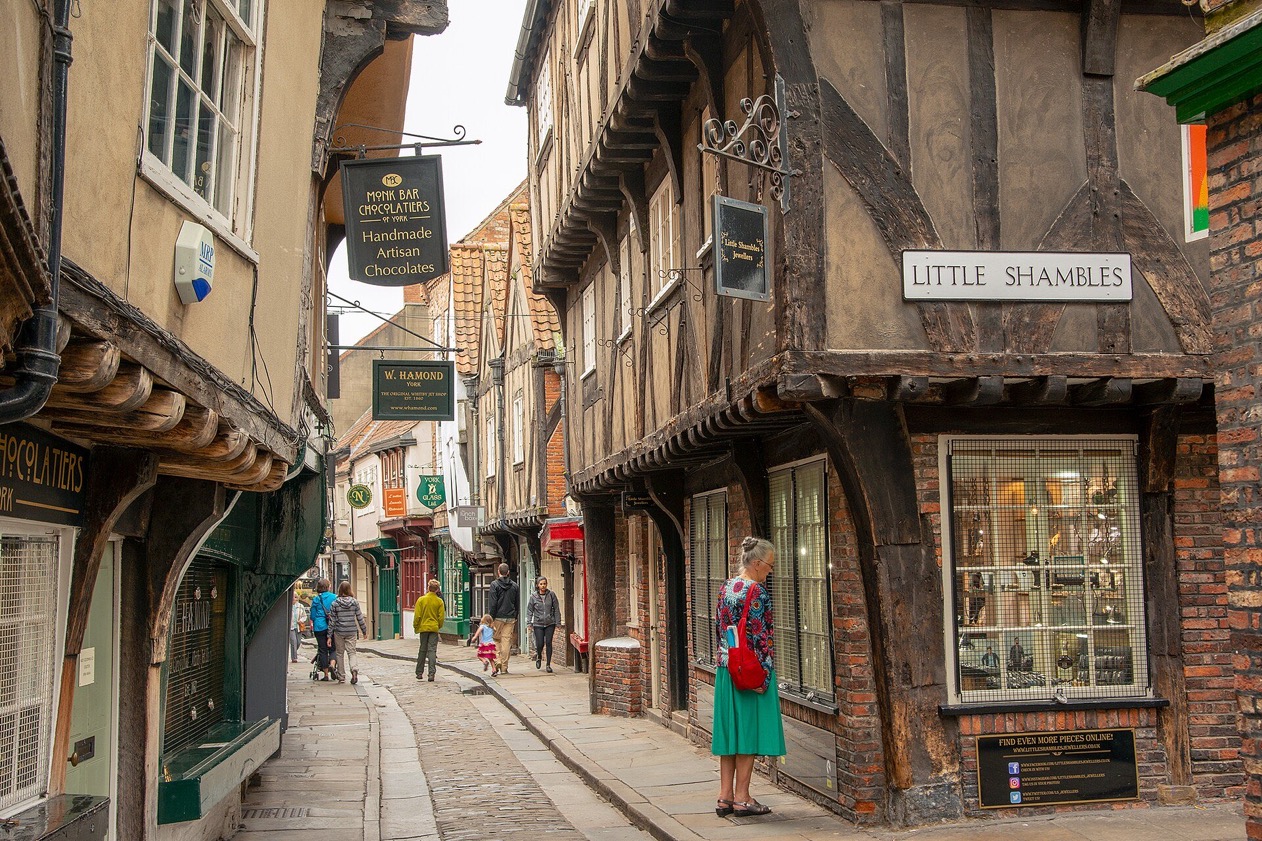
The side streets led me to the Shambles, a narrow, stone-paved street that I have never forgotten. It was lined with ancient buildings, some more than five centuries old, while modern shops occupied their interiors. The past there was alive, not displayed behind glass; all the scene lacked was the neighing of horses, the clatter of carriages and the clothes of people from bygone times.
I walked on excitedly, watching faces and listening to voices. The York accent was difficult for my ear to catch. My English teachers later told me that accents become more difficult the farther north one travels, while pronunciation in the south is clearer and its sounds easier to articulate. They called clear, standard English “Queen’s English”—the language of the Queen.
York at that time did not resemble London in its diversity. English people made up the overwhelming majority of its population, and I rarely saw a foreigner apart from some students and the owners of Indian and Turkish restaurants.
I had gone out to learn the route to the school, but I returned having begun to learn something of the way the city walked, spoke and lived. I was no longer a tourist passing through it; I was a new student trying to find my place there—even if that began by moving from the right-hand side of the pavement to the left!